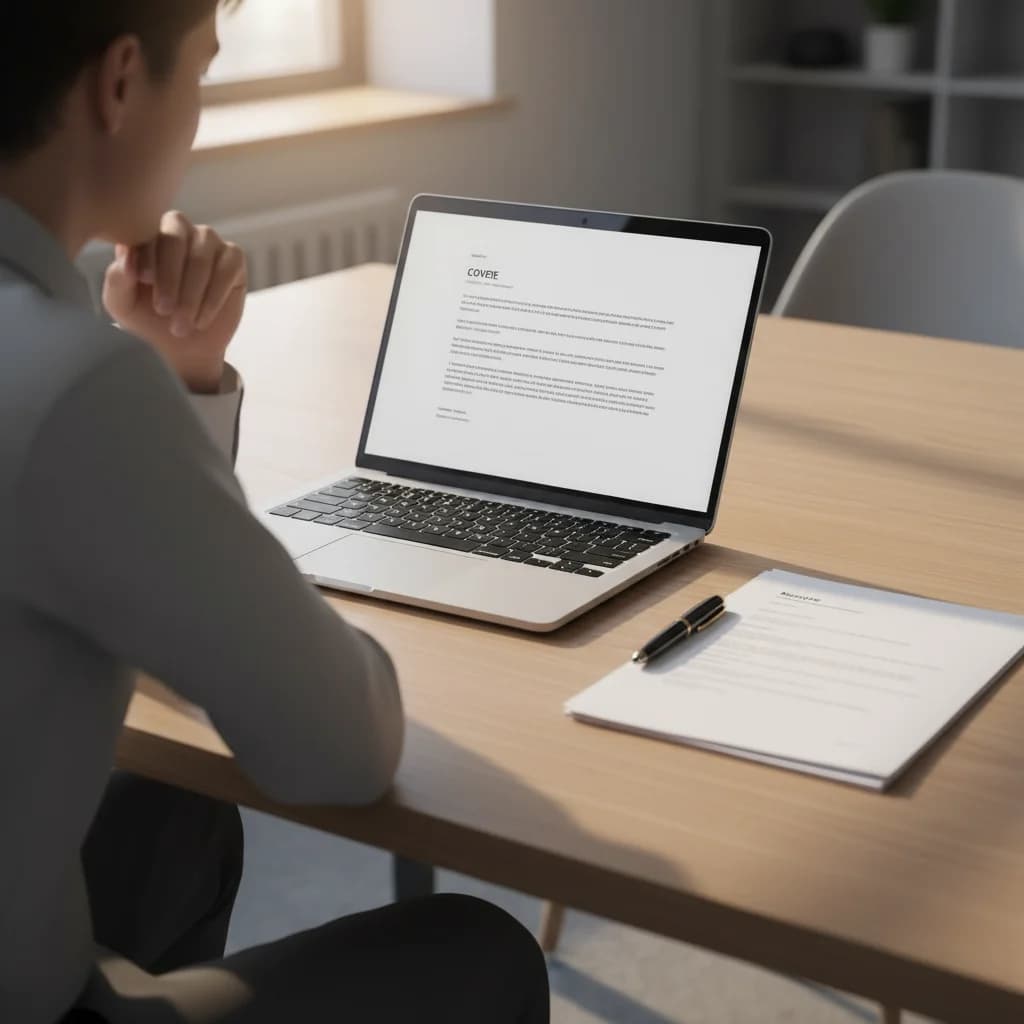
That Blank Page is Staring Back, Isn't It?
You’ve polished your resume until it shines. Every bullet point is a testament to your skill. Now comes the part that makes most people freeze: the cover letter. And the first question that paralyzes you is always the same: how long should this thing actually be?
Some guru on a blog told you half a page, max. A well-meaning professor once said a full page shows dedication. Your friend who just landed a job said nobody even reads them anymore. So, what’s the truth?
The truth is, your cover letter's length isn't about hitting a magic word count. It's about making a powerful, concise business case for yourself. It’s an argument for why you, out of hundreds of applicants, are worth a 30-minute conversation. Every sentence must serve that purpose. Wasting a hiring manager's time is the fastest way to the “no” pile.
As someone who has been on the other side of the hiring desk for years, I can tell you that we don't time how long we spend on your application. We scan. We look for clues. We want to see if you understand our problem and if you might be the solution. Your cover letter is the key that unlocks a closer look at your resume.
Key Takeaway: Stop thinking of your cover letter as a formality and start treating it like an executive summary. Its job is to be compelling, clear, and respectful of the reader's time.
The Modern Goldilocks Zone: Not Too Long, Not Too Short
Let's get the big question out of the way. The ideal cover letter in the current job market is three to four paragraphs, totaling between 250 and 400 words. This typically fits comfortably on a single page with proper formatting, often landing somewhere between a half and three-quarters of a page.
Why this length? It’s long enough to:
- Introduce yourself professionally.
- Show you've done your research on the company.
- Connect your top 2-3 qualifications directly to the job description.
- End with a confident call to action.
It’s also short enough that a busy recruiter or hiring manager can absorb it in under a minute. Anything longer, and you risk your key points getting lost. Anything shorter, and you might seem uninterested or unqualified.
Breaking Down the Perfect Structure
Format is just as critical as length. A clean, professional layout makes your letter easy to scan and shows you have an eye for detail. Here’s the blueprint.
This isn't the place to get creative. Just provide clear, professional contact information. This should match the header on your resume for consistent branding.
- Your Information: Full Name, Phone Number, Email Address, LinkedIn Profile URL (make sure it's a custom URL, not the default one with random numbers).
- Date: The date you are submitting the application.
- Company Information: Hiring Manager’s Name (if you can find it!), their Title, Company Name, and Company Address.
Pro Tip: Finding the hiring manager's name takes a little effort but pays off huge. Search LinkedIn for "Hiring Manager for [Department] at [Company]." If you can't find it, "[Department] Hiring Team" is a much better alternative than the stale "To Whom It May Concern."
2. The Opening Paragraph: Your Hook
Your first sentence is the most important. Do not waste it with "I am writing to express my interest in..." They already know that. You need to grab their attention immediately.
Start with enthusiasm and a direct connection. Mention the specific role you're applying for and where you saw it. Then, immediately hit them with your most relevant, impressive qualification or a statement that shows you understand their company's mission.
Example:
*"When I saw the Senior Product Manager opening on LinkedIn, I was immediately drawn to how the role combines user-centric design with data-driven strategy—two areas where I've spent the last five years delivering measurable results at TechCorp."
This opening is effective because it's specific, confident, and immediately aligns the applicant's experience with the role's core functions.
3. The Body Paragraphs (1-2): The Evidence
This is where you make your case. Do not—I repeat, do not—simply list the duties from your resume. That’s a surefire way to bore the reader. Instead, use these one or two paragraphs to tell a story that connects your past achievements to their future needs.
Here’s a powerful technique: The Problem/Solution Framework.
- Identify their problem: Read the job description carefully. What are the key challenges or goals mentioned? Are they trying to increase market share, streamline a process, or build a new platform?
- Present your solution: Use a specific example from your past where you solved a similar problem. Quantify it whenever possible.
Example:
*"The job description emphasizes the need for a leader who can scale customer support without sacrificing quality. In my previous role at Innovate Solutions, I was tasked with a similar challenge. I developed and implemented a new tiered support system and knowledge base that reduced ticket resolution time by 30% while our user base grew by 50%. I am confident I can bring that same strategic approach to developing and mentoring your team."
This paragraph shows you understand their need and have a proven track record of solving it. You've provided hard data (30% reduction, 50% growth) which is infinitely more persuasive than saying you have "strong leadership skills."
4. The Closing Paragraph: The Call to Action
End with confidence and clarity. Briefly reiterate your enthusiasm and your belief that you are a great fit for the role and the company culture. Then, state your desired next step.
Don't be passive. Instead of "I look forward to hearing from you," try something more proactive.
Example:
*"I am excited about the opportunity to contribute to [Company Name]'s mission of [mention something from their mission statement]. My experience in [Your Key Skill] aligns perfectly with the goals of this role, and I am eager to discuss how I can help your team succeed. Thank you for your time and consideration."
Finish with a professional closing like "Sincerely," or "Best regards,", followed by your typed name.
Many companies use Applicant Tracking Systems (ATS) to parse applications before a human ever sees them. Overly complex formatting can get your cover letter scrambled or rejected. Simplicity is key.
- Font: Stick to a clean, professional, and readable font. Good choices are Calibri, Arial, Georgia, or Helvetica in 10.5 to 12-point size.
- Spacing: Single-space your paragraphs and use a blank line between each one. This creates white space and makes the document much easier to read.
- Margins: Keep margins between 0.75" and 1".
- File Format: Always, always, always save and send your cover letter as a PDF. This is non-negotiable. A PDF preserves your formatting perfectly across all devices and operating systems. A .docx file can look completely different on the hiring manager’s computer, making you appear sloppy.
Warning: Sending a .docx or .pages file is a rookie mistake. It signals a lack of attention to detail. A PDF locks in your professional presentation.
What About Email Cover Letters?
Sometimes, the application instructions will ask you to paste your cover letter into the body of an email. In this case, brevity is even more critical.
Treat the email as a "cover note." Keep it to three short paragraphs:
- Opening: State the role you're applying for and your single most compelling qualification.
- Body: Briefly elaborate on that qualification with a specific, metric-based achievement.
- Closing: Express your excitement and state that your full resume is attached for their review.
The goal is to get them to open the attachment. That's it.
Your cover letter is not just a document; it's your opening argument. It’s your first and best chance to show a potential employer that you’re not just another applicant—you’re the solution they’ve been looking for. Keep it concise, compelling, and professional. Make it easy for them to say yes.