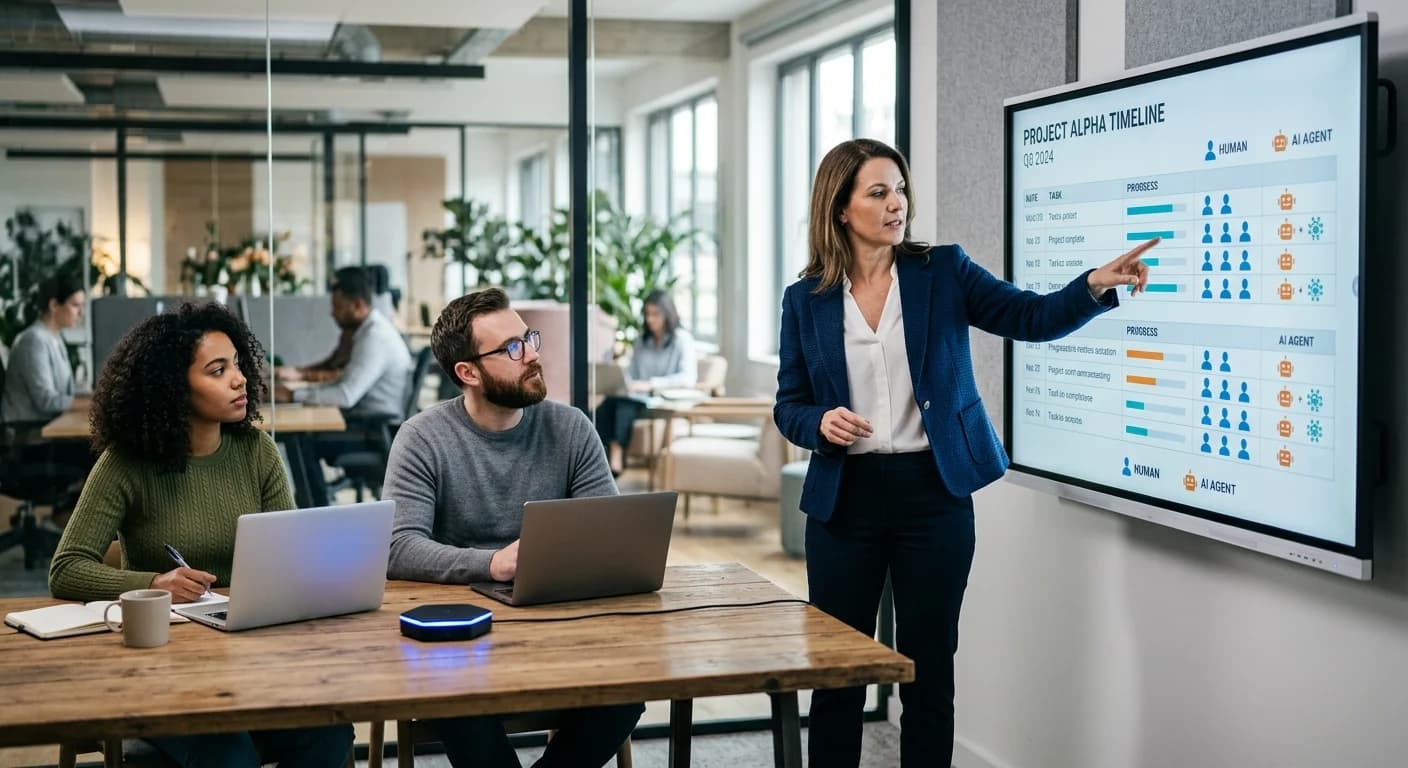
I remember the exact moment I realized my team had grown by five 'people' overnight, and none of them had a pulse. It was late on a Tuesday, and I was reviewing a quarterly marketing report that would have normally taken my lead analyst three days to compile. It was sitting in my inbox, perfectly formatted, cross-referenced with real-time competitor pricing, and optimized for three different stakeholder personas. My analyst hadn't stayed up all night. She had spent twenty minutes configuring a multi-agent workflow, then went to her daughter’s soccer game.
We are no longer in the era of 'using' AI. We have entered the era of the Second Workforce. This isn't about software; it’s about a parallel labor force of autonomous agents that can plan, execute, and iterate. If you are still managing your team like it’s 2023, you are already behind. The challenge now isn't just 'digital transformation'—it’s hybrid orchestration.
For years, we treated AI like a sophisticated calculator. You gave it an input, and it gave you an output. But the current generation of agentic AI—what I call the Second Workforce—doesn't wait for your every command. These agents have a degree of agency. They can use tools, browse the web, write code, and even 'talk' to other agents to solve problems.
In a modern enterprise, your org chart now has two layers. The first is your human talent: the creative, empathetic, and strategic core. The second is the agentic layer: the scalable, tireless, and hyper-logical execution force. Managing this dual-force requires a complete rethink of what 'leadership' actually looks like.
Pro Tip
Stop thinking about AI as a feature in your software. Start thinking about it as a 'digital employee' with a specific job description, a set of permissions, and a reporting line.
The New Org Chart: Orchestration, Not Task-Mastery
In the old model, a manager’s job was to break down big goals into small tasks and assign them to people. In 2026, that model is broken. If you spend your time assigning tasks that an agent can do, you are wasting human capital.
Instead, the role of the manager has shifted to Orchestrator. You are the architect of workflows. You don't just tell a human to 'write a report'; you design a system where an AI agent gathers the data, a human reviews the strategy, and another AI agent formats the delivery.
The Hybrid Responsibility Matrix
| Function | Human Role | AI Agent Role |
|---|
| Strategy | Defining 'Why' and 'What' | Scenario modeling and data-backed projections |
| Execution | Edge-case handling and final polish | Bulk processing, initial drafting, and research |
| Quality Control | Ethical oversight and brand alignment | Syntax checking, fact-verification, and formatting |
| Innovation | Connecting disparate ideas (Intuition) | Rapid prototyping and iterative testing |
Why Most Implementations Fail: The 'Prompt Engineering' Trap
I see many leaders making the same mistake: they think the solution is training every employee to be a 'prompt engineer.' That is a short-term fix for a long-term shift. Prompting is a conversation; management is a framework.
Real success with the Second Workforce comes from Workflow Design. It’s about building 'loops' where AI and humans hand off work seamlessly. If your human employees feel like they are just 'fixing' the AI’s mistakes all day, you haven't integrated the Second Workforce; you’ve just given your team a noisy, unreliable intern.
Common Mistake
Expecting AI to be 100% autonomous from day one. Even the most advanced multi-agent systems (MAS) require 'Human-in-the-Loop' (HITL) checkpoints to prevent drift and hallucinations.
The Human Advantage: What Machines Can’t Replicate
As the Second Workforce takes over the 'doing,' the 'being' becomes more valuable. I’ve spent the last year mentoring directors who are terrified their roles will disappear. My advice is always the same: double down on the things that don't have a training data set.
- Contextual Judgment: AI is great at logic but terrible at 'reading the room.' It doesn't know that a client is having a bad quarter or that a specific project is a 'pet project' for the CEO. Humans provide the context that makes the data actionable.
- Ethical Guardianship: As we deploy more agents, the risk of 'algorithmic bias' or unintended consequences grows. Humans must be the moral compass of the hybrid team.
- High-Stakes Empathy: In a world of automated responses, a genuine human connection is a premium product. Whether it’s managing a team conflict or closing a complex deal, empathy remains our greatest competitive advantage.
Managing the 'Junior Talent' Crisis
One of the most pressing challenges we face right now is the 'Junior Gap.' Historically, junior employees learned the business by doing the grunt work—the very work the Second Workforce now handles. If we automate all the entry-level tasks, how do we train the next generation of leaders?
As a mentor, I tell my mentees: your job isn't to do the grunt work anymore; it's to audit it. Instead of writing the code, you are reviewing the code generated by the agent. This requires a higher level of conceptual understanding earlier in a career. We are moving from 'learning by doing' to 'learning by supervising.'
The Sovereignty of Data and Governance
Managing a hybrid workforce isn't just about productivity; it’s about security. In 2026, 'Shadow AI'—employees using unauthorized agents to handle sensitive data—is the biggest threat to corporate integrity.
You need a clear governance framework. Who owns the output of an agent? If an agent makes a mistake that costs a client money, who is responsible? These aren't just legal questions; they are management questions.
Warning
Never allow an autonomous agent to have 'write' access to your core financial or customer databases without a human-authorized gatekeeper. The speed of an AI mistake can be catastrophic if not contained.
Building a Culture of 'Co-Intelligence'
Finally, we have to talk about the 'vibe.' There is a lot of unspoken anxiety in offices today. People see the Second Workforce and wonder, 'When is my turn to be replaced?'
A leader's job is to move the culture from a mindset of Replacement to a mindset of Augmentation. We use a framework called the Augmentation Loop to help teams identify which parts of their day drain their energy and which parts fill it. We then delegate the 'energy-drainers' to the Second Workforce.
When a team realizes that the AI isn't there to take their job, but to take the parts of their job they hate, the culture shifts. They stop being defensive and start being creative.
Moving Forward: Your First 90 Days
If you are ready to embrace the Second Workforce, don't start by buying a dozen new tools. Start by observing.
- Month 1: Audit your team’s workflows. Where are the bottlenecks? Which tasks are repetitive, high-volume, and low-context?
- Month 2: Pilot a single agentic workflow. Give it a specific 'job' and a human 'manager.' Focus on the hand-off points.
- Month 3: Evaluate and scale. Did the human manager feel more productive or more stressed? Adjust the 'supervision-to-execution' ratio accordingly.
The Second Workforce is here. It doesn't sleep, it doesn't need a 401(k), and it can process information faster than any human in history. But it lacks soul, it lacks context, and it lacks the ability to care about the outcome. That is where you come in. Your value as a leader in 2026 isn't measured by how much work you produce, but by how well you orchestrate the collective intelligence of both your human and digital talent.
Stop managing tasks. Start managing the system. The future of work isn't a choice between humans or AI—it’s the mastery of both.