The Uncanny Valley of Hiring
You are sitting in your spare bedroom, staring at a tiny green dot on your laptop. There is no one on the other side. No nodding recruiter, no 'mmm-hmm' of encouragement, and no chance to ask for clarification. Just a countdown timer and your own reflection. If that feels like a scene from a low-budget sci-fi movie, you are not alone.
Asynchronous video interviews—often called 'one-way interviews'—have become the standard first gate for many Fortune 500 companies and high-growth startups. In 2026, the technology has evolved from simple video recording to sophisticated platforms that analyze everything from your word choice to your micro-expressions. While candidates often find them cold or impersonal, employers see them as an essential tool for scaling their hiring process.
I have sat on both sides of this screen. I have designed these interview prompts for global tech firms, and I have coached hundreds of nervous professionals through them. Here is the reality: you cannot treat an asynchronous interview like a normal conversation. It is a performance, a presentation, and a data-entry exercise all rolled into one. To win, you need to understand the mechanics behind the curtain.
Why Companies Love (and Candidates Hate) the One-Way
Before we get into the 'how,' we need to talk about the 'why.' Companies do not use platforms like HireVue or Spark Hire because they want to make your life difficult. They use them to solve a massive logistical problem.
In a traditional round, a recruiter might spend 30 minutes on a phone screen. With an asynchronous setup, they can review your 5-minute highlight reel in 2 minutes. More importantly, it levels the playing field—every candidate gets the exact same questions, in the exact same order, with the exact same amount of time to prepare. This reduces the 'affinity bias' that happens when a recruiter spends 10 minutes talking about a shared hobby instead of your qualifications.
Key Takeaway
The one-way interview is a screening tool, not a final decision tool. Your goal is not to get the job in this round; your goal is to prove you are worth a 30-minute conversation with a human being.
The Tech Stack: Your Home is Now a Studio
In 2026, the 'good enough' approach to video quality is over. If your video is grainy or your audio sounds like you are in a wind tunnel, you are creating friction for the reviewer. Friction leads to rejection.
Lighting is Non-Negotiable
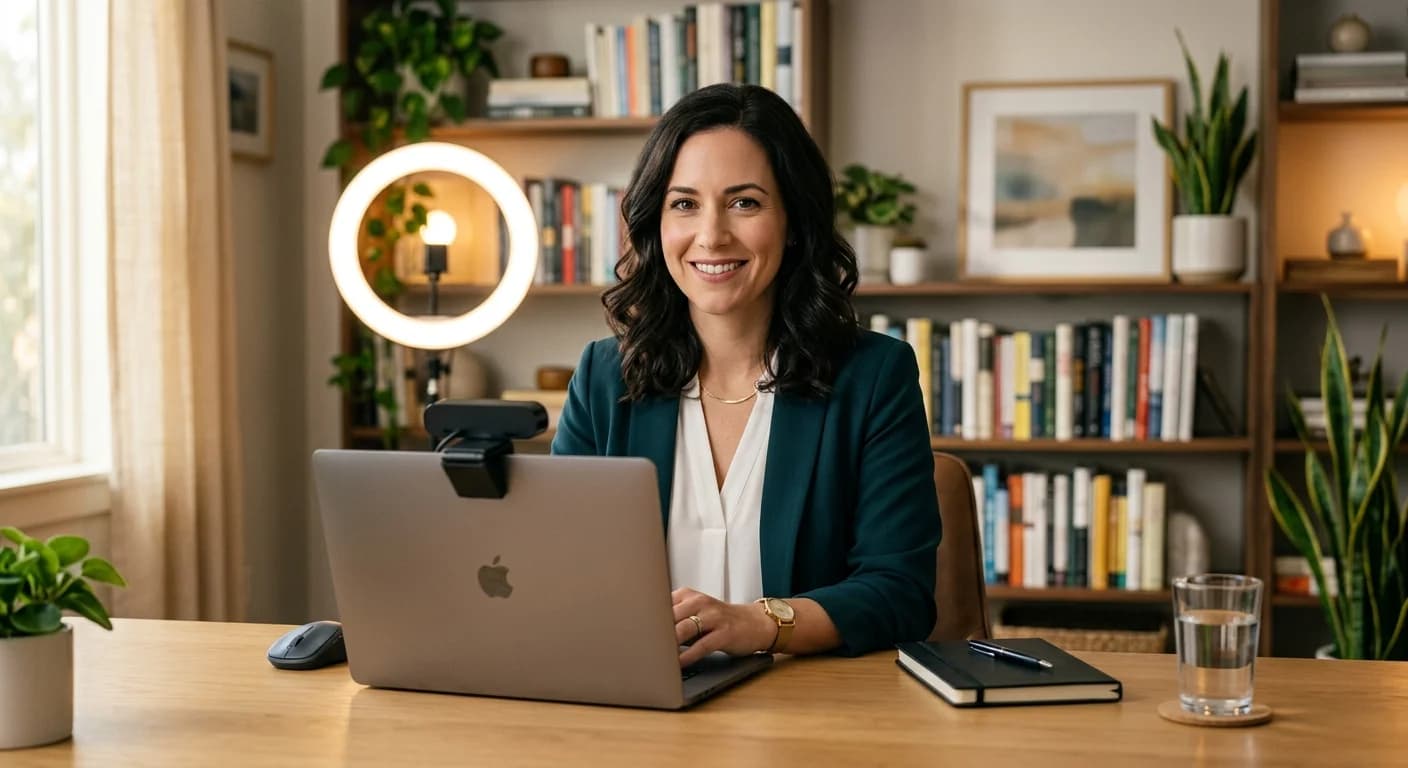
Do not rely on the overhead light in your room. It creates 'raccoon eyes' by casting shadows into your eye sockets. Instead, use a simple ring light or a desk lamp positioned directly behind your webcam. This illuminates your eyes, which is where the AI (and the human reviewer) looks for engagement and confidence.
The Audio Trap
Most people think the built-in microphone on their laptop is fine. It isn't. It picks up the hum of the cooling fan and the echo of the room. Use a dedicated headset or a lavalier mic. If you must use AirPods or Bluetooth buds, ensure they are fully charged. There is nothing more distracting than a candidate's audio cutting out mid-sentence because of a dead battery.
The Background Strategy
Your background should be boring. A clean bookshelf, a plain wall, or a professional-looking corner of an office. Avoid virtual backgrounds if possible; in 2026, the 'halo effect' around your head when you move still looks distracting and amateurish.
| Element | The "Bare Minimum" | The "Professional" Standard |
|---|
| Camera | Built-in 720p Laptop Cam | External 1080p/4K Webcam |
| Audio | Laptop Internal Mic | Wired Headset or USB Mic |
| Lighting | Ceiling Light / Window | Ring Light or 3-Point Lighting |
| Connection | Wi-Fi | Ethernet Cable (Hardwired) |
Content Strategy: The 90-Second Story
Most asynchronous platforms give you between 60 and 120 seconds to answer. This is where most candidates fail. They either ramble and get cut off mid-sentence, or they give a 20-second answer that lacks any substance.
Adapt the STAR Method
You likely know the STAR method (Situation, Task, Action, Result). For one-way interviews, you need to compress it.
- Situation/Task (15%): Set the stage quickly. "Last year, our churn rate spiked by 10%."
- Action (60%): This is the meat. What did you do? Use active verbs. "I audited our onboarding flow and implemented a three-step re-engagement sequence."
- Result (25%): Quantify the win. "Within three months, churn dropped to 4%, saving the company $200k in annual recurring revenue."
The "Hook" and the "Wrap"
Because there is no back-and-forth, you must signpost your answer. Start with: "That is a great question. Here is an example of how I handle high-pressure deadlines." End with: "That experience taught me the value of proactive communication, which is exactly how I would approach this role."
The AI in the Room: What is Actually Happening?
It is no secret that by 2026, AI is doing the heavy lifting in the initial screen. The software is not just looking at your face; it is transcribing your speech and running it through a Large Language Model (LLM) to check for 'competency fit.'
Keyword Optimization
Just like an ATS (Applicant Tracking System) scans your resume, the interview software scans your transcript for keywords related to the job description. If the job requires 'Stakeholder Management' and 'Agile Methodology,' make sure you use those exact phrases in your verbal answers.
Sentiment and Tone
Modern platforms analyze the 'sentiment' of your response. If you speak in a monotone or use overly negative language (even when describing a difficult situation), the AI may flag you as low-energy or high-risk. You do not need to be a cheerleader, but you do need to show professional enthusiasm.
Pro Tip
Practice your answers in front of a mirror or record yourself on your phone first. Watch for 'filler words' like 'um,' 'uh,' and 'like.' While a few are natural, a high density of filler words can confuse the transcription AI and make you seem unprepared.
Body Language and Energy: The 110% Rule
Video flattens your personality. If you speak with your normal level of energy, you will come across as bored on screen. You need to dial it up to about 110%.
This is the most common mistake I see. Candidates look at their own face on the screen while they talk. To the viewer, it looks like you are looking down or away. You must look directly into the camera lens. That lens is your interviewer. Put a small sticker or a picture of a friend right next to the lens to remind yourself where to look.
Posture and Gestures
Sit on the edge of your chair. It naturally forces your back straight and keeps your energy high. Use your hands to emphasize points, but keep them within the frame of the camera. If your hands are constantly flying off-screen, it creates a jarring visual experience.
The "Don'ts" List: Common Pitfalls
- Do not read from notes. It is incredibly obvious when a candidate's eyes are tracking lines of text on a screen. It kills your authenticity. Use bulleted sticky notes near the camera if you need prompts, but never read a script.
- Do not ignore the practice questions. Every platform offers a few 'dummy' questions. Use them. Not just to test your tech, but to get used to the weirdness of the countdown timer.
- Do not dress down. Just because you are at home doesn't mean you should wear a hoodie. Dress exactly as you would for an in-person interview. It changes your mindset as much as it affects the recruiter's perception.
- Do not forget the 'End Recording' button. Many platforms have a slight delay. After you finish speaking, maintain your smile and posture for two seconds before clicking 'Submit.' Don't let the last frame of your interview be you slumped over reaching for your mouse.
The Pre-Interview Ritual
Twenty minutes before you log in, do a 'hard reset.'
- Clear your space: Remove anything distracting from your desk.
- Hydrate: Have a glass of water nearby, but off-camera.
- Voice Warm-up: Hum or speak out loud for a few minutes. You don't want your first words of the day to be the start of your interview.
- Check your internet: Ensure no one else in your house is streaming 4K video or gaming while you are trying to upload high-definition interview files.
Moving Forward
Asynchronous interviews are a hurdle, but they are also an opportunity. Most people will show up unprepared, rambling, and poorly lit. By treating this like a professional production, you instantly put yourself in the top 10% of the candidate pool.
Remember: the technology is just a medium. Behind the AI and the algorithms, there is still a hiring manager who is looking for a person they can trust, collaborate with, and rely on. Use the tech to showcase that person.
Now, go find that green dot and show them what you've got.