I remember a Tuesday night about five years ago. I was staring at a spreadsheet that felt like it was written in an ancient, hostile language. A major supplier in Southeast Asia had gone dark due to a localized flood, and our entire production line in Mexico was three days away from a total shutdown. We had the data, but we didn't have the insight. We were reactive, exhausted, and frankly, guessing.
Fast forward to today. That specific brand of chaos hasn't disappeared, but the way we fight it has changed fundamentally. We’ve moved past the era of the 'Excel Warrior' and entered the era of the Supply Chain AI Specialist.
If you’re looking at career paths that offer both job security and the chance to solve high-stakes problems, this is it. But let’s be clear: this isn’t just another tech job. It’s a hybrid role that requires you to speak two very different languages—the language of the warehouse floor and the language of the neural network.
What is a Supply Chain AI Specialist?
In the simplest terms, a Supply Chain AI Specialist is the person who builds, deploys, and manages the intelligent systems that predict disruptions before they happen. They aren't just data scientists sitting in a vacuum; they are operational architects.
While a traditional data scientist might build a model to predict customer churn, a Supply Chain AI Specialist builds a multi-agent system that monitors geopolitical stability, weather patterns, and port congestion to automatically reroute a container ship before it even hits a storm.
This role is the 'bridge.' You are the person who explains to the VP of Operations why the AI recommended a 20% increase in safety stock for a specific SKU, and you’re the person who tells the engineering team why their model failed because it didn't account for the nuances of 'Last Mile' delivery in mountainous terrain.
Why This Role Exploded in Demand
The traditional supply chain broke during the early 2020s, and it never truly went back to 'normal.' The complexity of modern commerce—same-day delivery expectations, global volatility, and the push for sustainability—has outpaced human cognitive capacity.
We can no longer manage 50,000 SKUs across 10 countries using manual forecasting. Companies like Amazon and Maersk have set a bar so high that if a mid-sized company doesn't adopt AI, they simply won't exist in five years.
Pro Tip
The demand isn't just for people who can code. It's for people who understand domain-specific AI. Companies are tired of hiring generic AI experts who don't know the difference between a Bill of Lading and a Pallet Jack.
The Core Skill Set: More Than Just Python
To thrive here, you need a specific stack. If you're missing one of these pillars, you're just a consultant with a laptop, not a specialist.
1. Predictive and Prescriptive Analytics
It’s one thing to say, "We think demand will go up." It’s another to say, "Demand will go up by 14%, so we should trigger a purchase order for 5,000 units from Supplier B because Supplier A has a 40% risk of delay next month."
2. Agentic AI and LLM Integration
By 2026, we’ve moved beyond simple chatbots. Specialists are now building Agentic Workflows—AI agents that can actually execute tasks. This means an AI that doesn't just flag a delay, but actually emails the carrier, requests a quote for air freight, and presents the best three options to a human manager for a one-click approval.
3. Digital Twin Orchestration
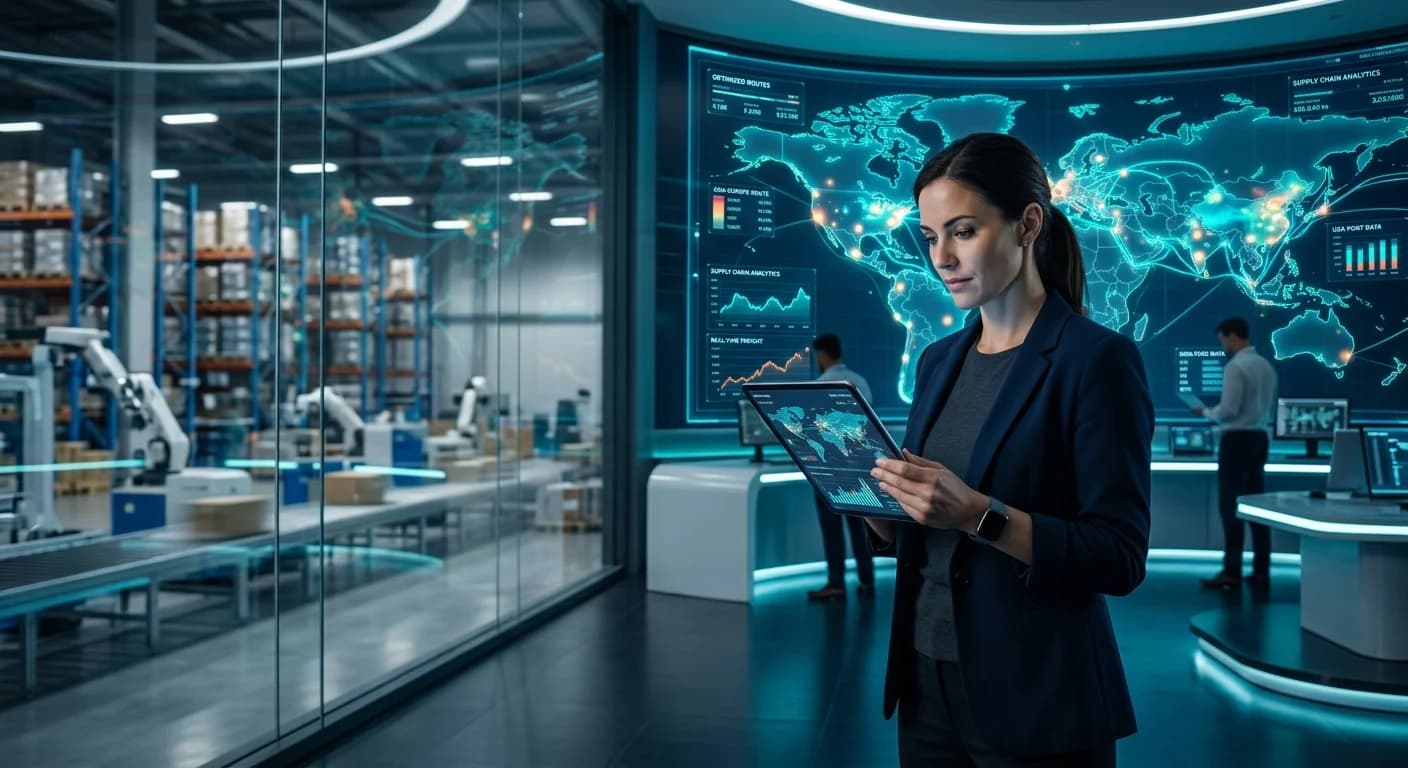
You’ll likely work with a Digital Twin—a virtual replica of the physical supply chain. Understanding how to feed real-time IoT data into these models is a non-negotiable skill.
4. Explainability (XAI)
This is where most people fail. If your AI tells a warehouse manager to move 10,000 units of inventory, and you can't explain why in plain English, that manager will ignore the AI. You must be able to peel back the 'black box' and build trust.
| Skill Category | Essential Tool/Framework | Real-World Application |
|---|
| Data Engineering | SQL, Snowflake, Databricks | Cleaning messy ERP data for model training. |
| Machine Learning | PyTorch, Scikit-learn | Building custom demand forecasting models. |
| Supply Chain | SAP IBP, Blue Yonder | Integrating AI insights into existing workflows. |
| Orchestration | LangGraph, AutoGen | Creating autonomous agents for procurement. |
A Day in the Life: From Dashboard to Dock
What does this actually look like on a Tuesday morning? It’s not just coding. It’s a mix of strategic troubleshooting and technical refinement.
- 09:00 AM: Review the 'Anomaly Report.' The AI flagged a weird spike in lead times from a chemical supplier in Germany. You investigate and realize the model caught a labor strike announcement before it hit mainstream news.
- 11:00 AM: Meeting with the Logistics Team. They’re complaining that the AI is being 'too conservative' with fuel estimates. You dive into the weights of the routing algorithm to see if it’s over-prioritizing safety over speed.
- 02:00 PM: Deep work. You’re fine-tuning a Large Language Model to parse thousands of PDF contracts to find 'Force Majeure' clauses that might be triggered by recent geopolitical shifts.
- 04:30 PM: Presenting to the C-Suite. You aren't showing them code; you’re showing them how your new 'Inventory Optimizer' saved the company $2.4 million in carrying costs last quarter.
The "Human in the Loop" Fallacy
One of the biggest mistakes companies make—and where you, as a specialist, provide the most value—is thinking AI can run the show solo. I’ve seen companies turn on 'Auto-Pilot' for procurement and end up with three years' worth of a product that went out of style two months later because the AI didn't understand a viral trend shift on social media.
Your job is to design the Human-in-the-loop (HITL) systems. You decide where the AI has the autonomy to act and where it must stop and ask a human for permission. This is a design challenge as much as it is a technical one.
Warning
Never trust a model that hasn't been stress-tested against 'Black Swan' events. If your training data only includes 'good times,' your AI will be useless when the next global crisis hits.
How to Transition Into This Career
If you’re already in Supply Chain, you have the domain knowledge—which is the hardest part to teach. Your path is to aggressively upskill in Python, data structures, and the basics of LLM orchestration. You don't need a PhD in Mathematics, but you do need to understand how to evaluate a model's performance.
If you’re a Data Scientist looking to move into this field, you need to get your hands dirty. Go to a warehouse. Watch how a truck gets loaded. Understand why 'Last Mile' is the most expensive part of the journey. Without that context, your models will be mathematically perfect but operationally useless.
Recommended Learning Path:
- Master the Fundamentals: Take the MIT MicroMasters in Supply Chain Management. It is the gold standard for understanding the math behind the movement of goods.
- Learn the Tech: Focus on 'Time Series Forecasting' and 'Reinforcement Learning.' These are the two branches of ML most relevant to logistics.
- Get Certified: Look into the ASCM (Association for Supply Chain Management) certifications, specifically those focusing on digital transformation.
The Reality of the Paycheck
Let’s talk numbers, because they are significant. In 2026, a mid-level Supply Chain AI Specialist is easily commanding a salary 30-40% higher than a traditional Supply Chain Analyst. In major hubs, total compensation packages for senior roles are frequently crossing the $200k mark, often with significant performance bonuses tied to the cost savings generated by their models.
Companies aren't paying for your time; they are paying for the millions of dollars in waste you eliminate. When you can reduce 'deadhead' miles for a fleet of 500 trucks by even 5%, the ROI on your salary is instantaneous.
The Road Ahead
We are moving toward a 'Self-Healing Supply Chain.' This is a system that doesn't just report problems but fixes them—reordering parts, shifting production schedules, and notifying customers—all in real-time.
Being a Supply Chain AI Specialist means you are the one holding the screwdriver for that system. It is high-pressure, but it is also one of the few roles where you can see the direct physical impact of your code in the real world. Every time you see a product on a shelf, you’ll know the invisible, intelligent web you helped build to get it there.
If you want a career where you're constantly learning and your work actually moves the world, stop looking at generic tech roles. The warehouse is where the real revolution is happening. Get started by identifying one manual process in your current reach and ask: 'How would an AI agent handle this?' That’s where your journey begins.