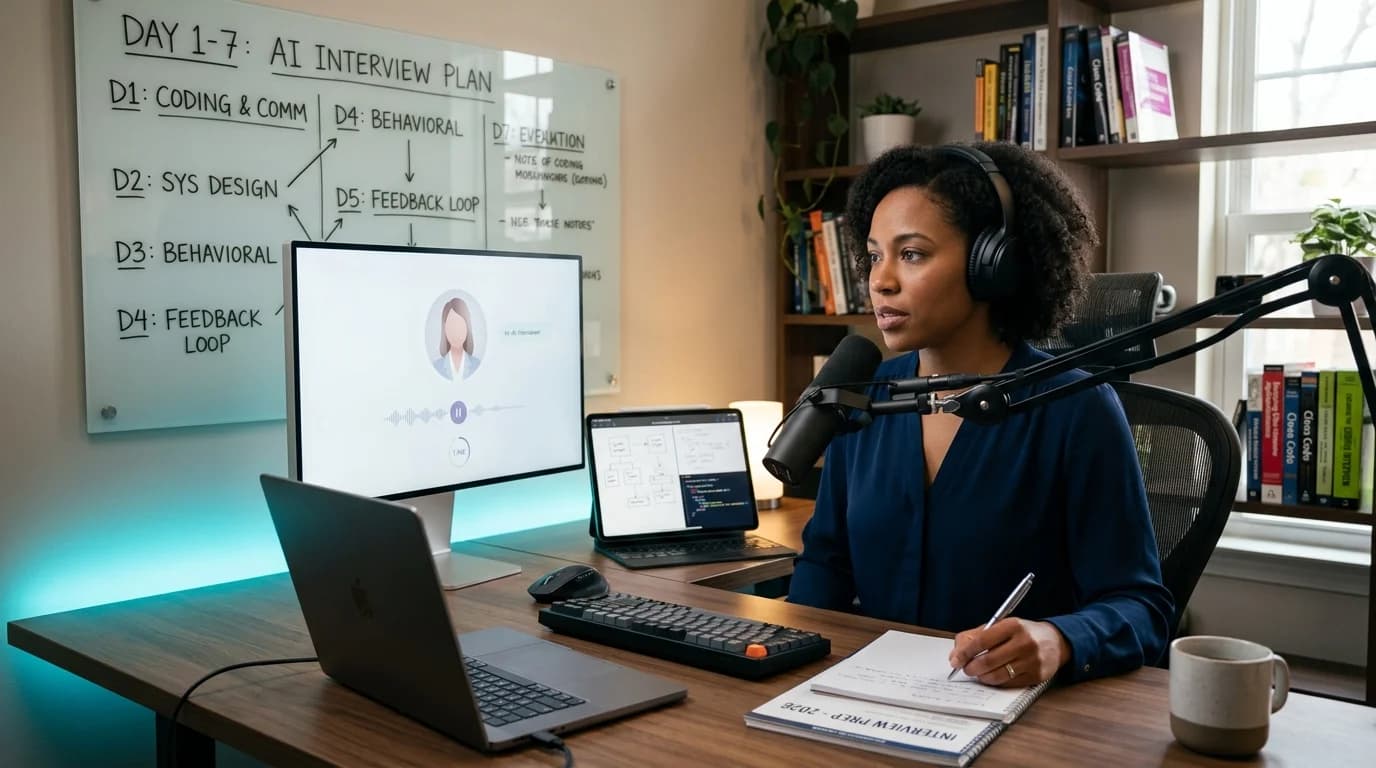
AI can make interview practice more realistic, more frequent, and easier to measure. It cannot replace technical knowledge, truthful experience, or the judgment of a human interviewer. The right approach is to use an AI mock interviewer as a demanding practice partner: answer out loud, accept follow-up questions, inspect the transcript, and repeat the weakest part.
This guide presents a practical AI mock interview practice for software engineers 2026 workflow. It combines coding communication, system design, behavioral evidence, and a seven-day improvement loop. The goal is not to memorize perfect scripts. It is to become clearer under pressure while preserving your own reasoning and voice.
Why AI mock interviews are especially useful in 2026
Interview preparation tools increasingly generate role-specific questions from job descriptions and provide feedback on recorded or typed answers. LinkedIn's current AI interview prep documentation, for example, describes job-specific practice, transcripts, feedback, and readiness signals. That reflects a broader shift: candidates can now run realistic practice sessions without coordinating another person's calendar.
The benefit is repetition. A human mock interview may be valuable but difficult to schedule every day. An AI session can help you rehearse the same skill several times, compare versions, and notice habits such as rushing into code, skipping assumptions, or giving behavioral answers without results.
The limitation is equally important. AI feedback can be incomplete, generic, or wrong. Treat every score as a hypothesis, not a hiring prediction. Your real standard should be whether the answer is technically correct, supported by evidence, understandable to another engineer, and responsive to the question.
A vague instruction such as “interview me for a software engineering job” creates vague practice. Supply a role brief with the title and level, five essential qualifications, interview format, preferred language, session length, and weakest skills.
Use the keyword and skill map from your ATS resume strategy as the starting point. If the role emphasizes distributed systems, stakeholder communication, and Python, test all three instead of drawing random questions.
Apply one consistent rubric. For technical answers, score problem framing, clarification, correctness, tradeoffs, communication, and testing. For behavioral answers, score relevance, ownership, specific actions, outcome, and reflection. A stable rubric makes repeated sessions comparable.
The seven-day AI mock interview plan
Day 1: Establish a recorded baseline
Choose one role and run a 30-minute mixed interview without preparation immediately beforehand. Include one coding problem, one project deep dive, and two behavioral questions. Answer out loud if the tool supports voice.
Do not stop to rewrite an answer. The first session should reveal your current habits. Afterward, save only five observations:
- One technical gap.
- One communication habit.
- One weak or missing example.
- One strong answer to preserve.
- One priority for the next session.
Also create a story inventory from your resume. List eight experiences covering delivery, conflict, failure, leadership, ambiguity, customer impact, technical judgment, and learning. Early-career candidates can use projects, coursework, volunteering, or internships; the resume-with-no-experience guide shows how to identify credible evidence outside formal employment.
Day 2: Train coding communication
Run three 20-minute coding drills. Ask the interviewer to interrupt when an assumption is unclear and to request complexity analysis and tests before ending the problem.
Microsoft's current technical interviewing guidance emphasizes clarifying ambiguity, planning before implementation, writing real code, and testing boundaries and error conditions. Amazon's software development interview topics similarly recommends practicing fundamentals and coding outside an integrated development environment.
Use this sequence for every problem:
- Restate the problem in your own words.
- Confirm inputs, outputs, constraints, and edge cases.
- Describe a straightforward solution.
- Improve it only when the tradeoff is justified.
- Implement while narrating decisions.
- Test with a normal case, boundary case, and failure case.
- State time and space complexity.
Ask the AI to flag only moments where a human listener would lose the thread. This is more useful than requesting a fully rewritten solution.
Day 3: Practice follow-up pressure
Many candidates can solve the initial problem but struggle when requirements change. Ask for one base question followed by five progressively harder modifications.
For a cache problem, the follow-ups might introduce expiration, concurrency, memory limits, persistence, or regional replication. For an API design, they might introduce rate limits, idempotency, retries, or partial failure.
Pause briefly after each change. State which assumption changed, what remains valid, and what must be redesigned. This trains adaptability without pretending that instant answers are required.
Use a company-specific guide, such as the Microsoft software engineer interview guide, to select realistic themes. Do not ask the AI to impersonate an employee or claim confidential knowledge. Ask it to use public role expectations and the supplied job description.
Day 4: Build a system-design narrative
Choose one familiar system: a notification service, URL shortener, job scheduler, chat service, or rate limiter. Run a 45-minute design interview.
Use a stable narrative:
- Clarify users, scale, latency, consistency, durability, and privacy.
- Name functional and non-functional requirements.
- Estimate only the numbers that influence architecture.
- Draw or describe the major components.
- Follow one request through the system.
- Identify the bottleneck and likely failure mode.
- Discuss one alternative and why you rejected it.
- Close with monitoring, rollout, and remaining risks.
Ask the AI for adversarial follow-ups, but require it to identify the assumption behind each challenge. A question such as “What happens if traffic grows?” is weak. “What happens when write traffic increases tenfold while reads remain stable?” creates a useful design decision.
Day 5: Strengthen behavioral evidence
Prepare six questions tied to the role's competencies. Answer each in two minutes, then allow two minutes of follow-up.
Use STAR or STAR(R): situation, task, action, result, and reflection. Microsoft recommends STAR(R) in its general interview tips, while also asking candidates to share their thinking and rationale.
The action section should be the longest. Replace “we decided” with the decisions you personally made, while still acknowledging the team. Quantify scope when the number is real: users, incidents, latency, revenue, deadline, team size, or error rate. End with what you learned and what you would change.
Ask the AI to challenge vague ownership, missing tradeoffs, and unsupported results. Never let it invent a metric, employer detail, or outcome. If a number is unavailable, use concrete scope instead.
Day 6: Run a full interview simulation
Create a 60-minute session with realistic pacing:
- Five minutes for introductions.
- Twenty minutes for coding.
- Twenty minutes for system or project design.
- Ten minutes for behavioral questions.
- Five minutes for your questions.
Disable hints during the session. Ask for follow-ups one at a time and feedback only at the end. Use your preferred language, a simple editor, and the same audio setup you expect to use on interview day.
A useful practice tool is an AI interview copilot that can structure questions and feedback, but the session should still test your independent thinking. During a real interview, follow the employer's rules about permitted tools. Assistance is not permission to receive undisclosed live answers.
Day 7: Retest the weakest skill
Do not repeat the entire simulation. Select the two lowest rubric scores and run targeted drills.
If clarification was weak, practice opening questions for five unfamiliar problems. If behavioral answers lacked evidence, rebuild three stories and test follow-ups. If testing was weak, inspect five solutions and generate edge cases before writing code.
Finish with the same mixed questions used on Day 1 or questions of comparable difficulty. Compare observable behavior, not just an AI score:
- Did you clarify sooner?
- Did you create a plan before coding?
- Were transitions easier to follow?
- Did you test without prompting?
- Were examples more specific?
- Did you recover calmly after a mistake?
Write the next week's plan using those answers.
Use a feedback ledger instead of collecting scores
After every session, record the question type, strongest behavior, highest-risk gap, and next drill. For example: “Coding; clear complexity analysis; started before confirming constraints; complete three clarification-only drills.”
A score without evidence is hard to use. A short ledger converts feedback into action. Limit each session to one or two changes so your answers stay natural.
A reusable prompt for a technical mock interview
Use a prompt like this:
Act as a structured software engineering interviewer for a mid-level backend role. Use the job requirements I provide. Ask one question at a time. Do not give solutions or hints unless I request them. Challenge unclear assumptions, ask for complexity and tests, and add two realistic follow-ups. At the end, score problem framing, correctness, tradeoffs, communication, and testing from one to five. Quote short excerpts from my answer as evidence and identify one drill for tomorrow.
Add your role brief and verified background. Remove proprietary code, customer data, internal incidents, personal identifiers, and anything covered by confidentiality obligations.
Common mistakes that reduce the value of AI practice
- Memorizing generated answers: A polished script can collapse after one follow-up. Learn the structure and evidence, not exact sentences.
- Practicing only comfortable topics: Set a topic distribution so weak areas such as concurrency, graphs, conflict, or failure stories appear.
- Accepting feedback without checking it: Verify algorithms, complexity, cloud claims, and design advice with official documentation, tests, or an experienced engineer.
- Optimizing for a score: Retest with fresh questions and measure observable behavior. Familiarity with one tool is not the same as readiness.
- Displaying knowledge instead of answering: Lead with the requested decision, then add depth when asked.
- Using live assistance without permission: Employer policies vary. Ask which tools, references, and environments are permitted, and follow the answer.
Protect privacy and interview integrity
Practice transcripts can contain professional history, project details, voice recordings, or video. Review the tool's data controls before using it. LinkedIn's AI interview information explains that practice and screening sessions process recordings, transcripts, and generated insights differently, which is a useful reminder to distinguish private practice from an employer-facing assessment.
Use sanitized examples. Describe a “payments service” rather than naming a confidential customer. Replace exact internal architecture with the public technical lesson. Do not upload private interview questions obtained under an agreement.
AI can help you prepare, but your real interview should represent your own knowledge and experience. That boundary protects both credibility and learning.
Frequently Asked Questions
How often should software engineers do AI mock interviews?
Three to five focused sessions per week is enough for many short preparation cycles. Review each transcript and schedule one full simulation.
Should technical and behavioral questions be practiced together?
Build weak skills in separate drills, then combine coding, design, and behavioral questions to test transitions and endurance.
Can an AI score predict whether I will pass?
No. The tool does not know the complete rubric, candidate pool, team needs, or hiring discussion. Use scores only to locate practice areas.
What if the AI gives incorrect technical feedback?
Ask for assumptions and a counterexample. Verify the claim with official documentation, a test, or a trusted engineer before changing your approach.
Is AI allowed during a live interview?
Only when the employer explicitly allows it. Ask beforehand if the rules are unclear, and never conceal real-time assistance.
How do I avoid sounding rehearsed?
Memorize structure and evidence rather than sentences. Practice the same story against differently worded questions and allow interruptions.
What is the fastest improvement for a coding interview?
Use a consistent opening: restate the problem, clarify constraints, outline a plan, and then code. This reduces preventable errors and makes your reasoning visible.
Final takeaway
The best AI mock interview practice for software engineers in 2026 is a measured loop: simulate, inspect, isolate one weakness, drill it, and retest. Keep the questions tied to the role, check technical feedback, protect confidential information, and preserve your independent voice. Seven disciplined days can make your existing knowledge easier to demonstrate.