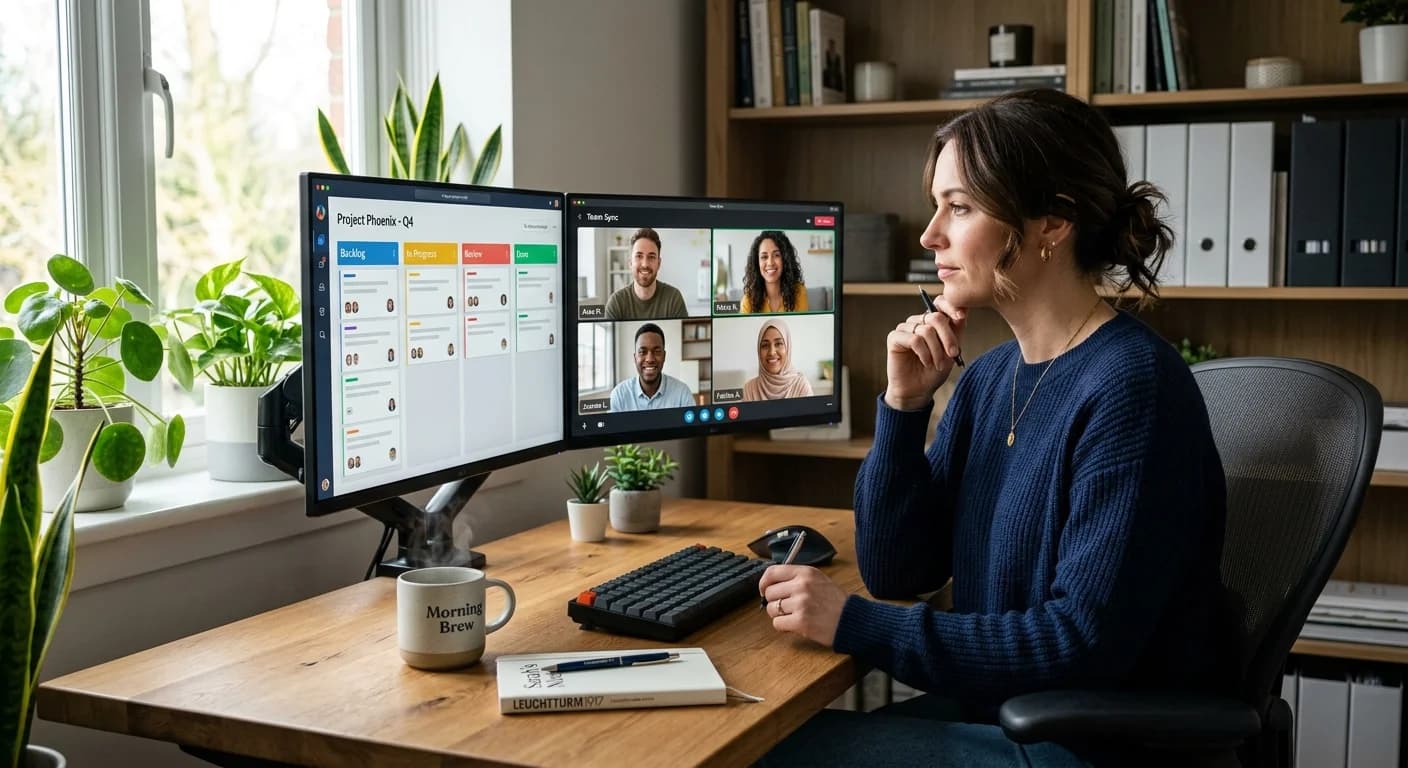
The 'Wednesday morning wall' is a real thing. You spent Monday and Tuesday at home, crushing through deep work in your sweatpants. Then Wednesday hits. You’re back in the office, staring at a screen while your coworkers have loud conversations three desks over. You realize you’re doing the exact same work you did yesterday, just with a longer commute and more distractions. If this sounds familiar, you aren’t failing at hybrid work—you’re just using an outdated operating system for a modern reality.
By now, the debate over whether hybrid work 'works' is over. It’s the standard. But most professionals are still stuck in a messy middle ground where they feel neither fully connected to their team nor fully productive at home. To win in this environment, you have to stop viewing hybrid work as a location-based schedule and start viewing it as a strategic management of your energy and output.
The Synchronous vs. Asynchronous Divide
The biggest mistake people make in a hybrid setup is trying to replicate the 9-to-5 office rhythm at home. When you’re remote, your greatest asset is asynchronous communication. This means you don’t need an immediate response to every ping, and you don’t need to be 'on' every second of the day.
High-performing hybrid workers categorize their tasks into two buckets: High-Friction and Low-Friction.
- High-Friction Tasks: These require nuance, emotional intelligence, or rapid-fire brainstorming. Examples include conflict resolution, performance reviews, or creative kick-offs. These belong in the office or on a high-bandwidth video call.
- Low-Friction Tasks: These are execution-based. Writing reports, coding, data analysis, or clearing your inbox. These are best done in isolation where you can enter a flow state.
Pro Tip: Never use your office days for low-friction tasks. If you’re going into the building just to sit on Zoom calls all day, you are wasting your time and your company’s money. Protect your office time for collaboration and your home time for deep work.
Designing Your 'Digital Commute'
One of the most underrated challenges of working from home is the lack of a 'buffer' between your personal life and your professional life. In the old days, the physical commute acted as a psychological reset. Without it, work-life bleed leads to burnout faster than you can say 'burnout.'
Create a digital commute. This is a 15-minute ritual that signals to your brain that the workday has begun or ended. It could be a walk around the block, a specific playlist, or even just clearing your physical desk. When the ritual is done, the laptop stays closed.
Research from the Harvard Business Review suggests that rituals significantly reduce anxiety and improve focus. In a hybrid world, these boundaries aren't just 'nice to have'—they are your primary defense against the 'always-on' culture.
The Rule of Three: When to Stop Typing
We’ve all been there: a simple question on Slack turns into a 40-minute back-and-forth that leaves everyone frustrated. To fix this, implement the Rule of Three.
If a text-based conversation goes back and forth more than three times without a resolution, stop typing. Pick up the phone or jump on a quick huddle. Text is terrible for nuance. It’s great for updates, but it’s a productivity killer for problem-solving. By moving to a voice or video medium quickly, you save hours of potential misunderstanding.
| Communication Channel | Best For... | Worst For... |
|---|
| Slack/Teams | Quick updates, links, social banter | Complex feedback, conflict resolution |
| Email | Formal documentation, external clients | Urgent questions, brainstorming |
| Video/F2F | Relationship building, strategy, difficult news | Status updates that could be a bulleted list |
Managing Up and Fighting Proximity Bias
Let’s be honest about a hard truth: Proximity bias is real. Managers often subconsciously favor the people they see physically every day. If you are working remotely more often than your peers, you have to be more intentional about your visibility.
This doesn't mean 'performative busyness.' It means making your impact visible.
- The Friday Wrap-Up: Send a short, three-bullet email to your manager every Friday afternoon. Include what you accomplished, what’s blocked, and what’s on deck for next week. It keeps them informed without them having to ask.
- Active Participation: In hybrid meetings, the people in the room often dominate the conversation. If you’re the remote participant, don't wait for a gap. Use the 'raise hand' feature or speak up early to establish your presence.
- Social Capital: Use your office days for 'watercooler' moments. Don't eat lunch at your desk. Go to the breakroom. These informal interactions are where trust is built, and trust is the currency that allows you to work flexibly without being micromanaged.
The Technical Debt of Hybrid Work
By mid-2026, the tools we use have evolved, but our habits often haven't. We are seeing a massive shift toward collaborative canvases (like Miro or FigJam) and AI-driven documentation.
If your team is still relying on 'who remembers what was said in the meeting,' you are accruing technical debt. Every decision made in a hybrid environment must be documented in a central, searchable location. This ensures that the person working from home on Tuesday has the same context as the person who was in the room on Monday.
Key Takeaway: Documentation is an act of inclusion. When you write things down, you ensure that location doesn't dictate information access.
Ergonomics and the 'Secondary Office'
If you’re still working from your kitchen table, you’re hurting your long-term productivity. Your physical environment dictates your mental clarity.
Invest in a dedicated workspace. This doesn't require a separate room, but it does require a 'work-only' zone. A high-quality chair, a second monitor, and decent lighting for video calls are professional requirements, not luxuries. If your company offers a remote work stipend, use every cent of it. A standing desk converter or a high-quality microphone can change the way you show up to work every day.
Overcoming the 'Ghost Office' Syndrome
There is nothing worse than commuting for an hour only to find out you’re the only person from your team in the office. This is 'Ghost Office' syndrome, and it’s a morale killer.
To avoid this, teams must coordinate their 'anchor days.' These are specific days when the whole team agrees to be on-site. These days should be intentionally light on solo work and heavy on team-building, 1-on-1s, and collaborative sessions. If you’re a leader, don’t mandate days just for the sake of it—mandate them for the sake of the connection they provide.
The Future is Fluid
Hybrid work isn't a set of rules; it’s a set of experiments. What works for a software engineering team might not work for a marketing agency. The most productive hybrid workers are those who are constantly iterating on their process.
Ask yourself every month:
- When did I feel most drained this month?
- Which meetings could have been an email?
- Do I feel connected to my team's mission?
If the answers aren't what you want, change the variables. Move your 'office' days. Tweak your 'digital commute.' Hybrid work is the first time in history where we have this much control over our environment and our schedule. Don't waste that freedom by sticking to old habits.
Success in this new era isn't about how many hours you spend in a specific chair. It’s about how effectively you manage your focus, your relationships, and your results. Own your schedule, or it will surely own you.