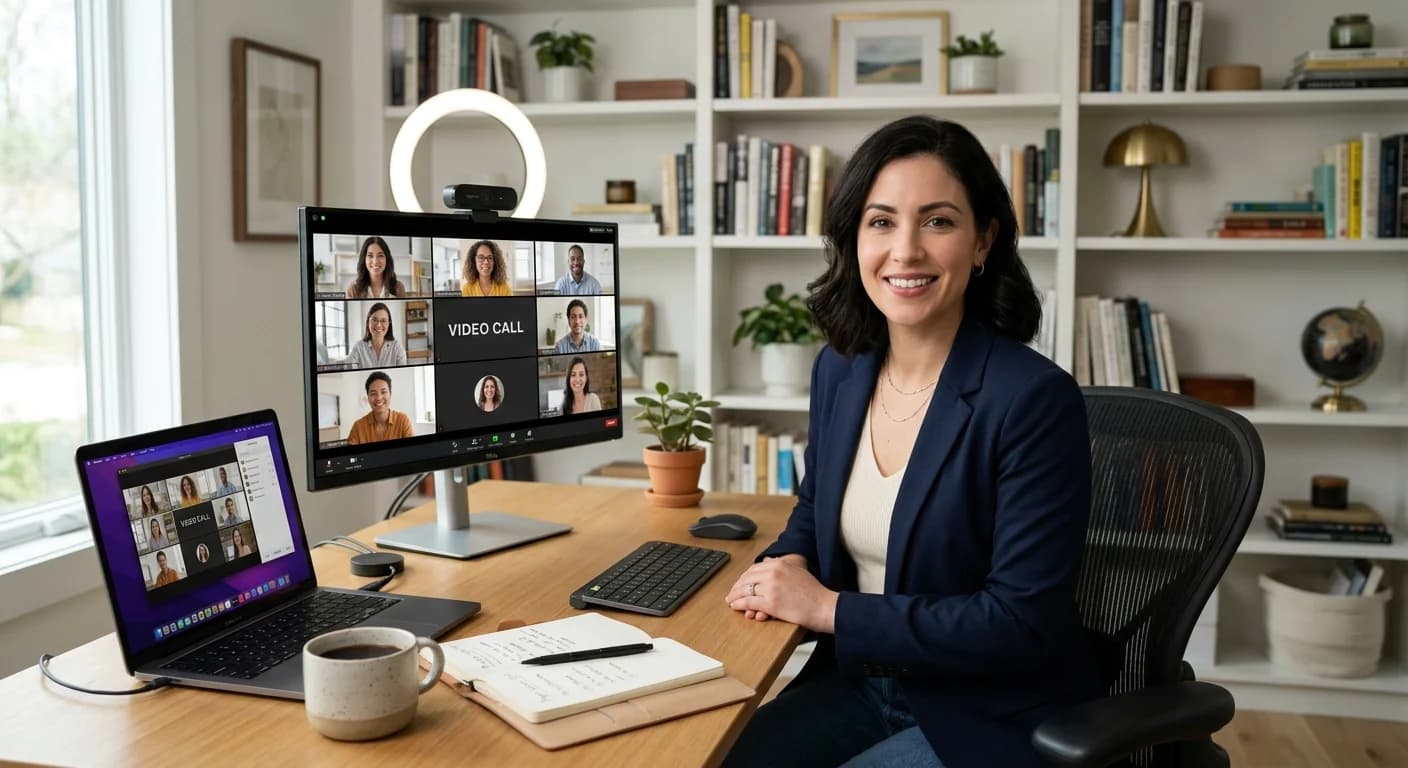
I recently sat in a debrief for a Senior Product Manager role. We had two finalists. Candidate A had a flawless resume, Ivy League pedigree, and ten years at a blue-chip tech firm. Candidate B had a solid but less 'prestigious' background, worked for three different mid-sized startups, and lived in a different time zone.
In a 2019 office-first world, Candidate A wins every time. But in today’s remote-heavy market, we hired Candidate B. Why? Because Candidate A struggled to troubleshoot their audio for three minutes, sent follow-up emails that were blocks of unformatted text, and couldn't clearly articulate how they manage their own schedule. Candidate B, meanwhile, had a dedicated home setup, communicated with surgical precision in writing, and demonstrated a level of self-sufficiency that made the hiring manager feel they could 'set it and forget it.'
When you apply for a remote job, the scorecard changes. Managers aren't just looking for your ability to do the task; they are looking for your ability to do the task in isolation. They are terrified of hiring a 'ghost'—someone who needs constant hand-holding or someone who disappears when a problem arises.
The Trust Deficit: Why Remote Hiring is High Stakes
In a physical office, a manager can see you at your desk. They see you collaborating. They see you 'working.' This creates a baseline of trust, even if it’s often unearned. In a remote environment, that visibility vanishes.
Remote managers operate with a 'trust deficit' by default. To overcome this, they evaluate candidates through a lens of digital reliability. They are looking for signals that you won't become a management burden. This is why the evaluation process for remote roles is often more rigorous regarding communication style and technical self-sufficiency than the job itself.
The 'Writing as a Superpower' Filter
In a distributed team, your writing is your presence. If your emails are vague, your Slack messages are fragmented, or your project updates are non-existent, you are effectively invisible—or worse, a nuisance.
Employers now look for 'asynchronous fluency.' They want to see if you can convey complex ideas without needing a 30-minute sync. During the interview process, pay attention to every written touchpoint:
- The Follow-up: Is it a generic 'Thanks for your time,' or does it summarize key points and address a specific challenge discussed?
- The Assessment: If there is a take-home assignment, how do you document your process? High-quality documentation is often more important than the final result.
- Clarity over Cleverness: Avoid jargon. Use bullet points. Make your thoughts skimmable.
Pro Tip
Treat every email to a recruiter or hiring manager as a work sample. If you can't manage a thread professionally during the interview phase, they will assume you’ll be a nightmare in the company Slack.
The Technical 'Vibe Check'
We are past the era where 'being good with computers' is a skill. In 2026, technical self-sufficiency is a survival trait. When an employer evaluates a remote candidate, they are silently auditing your digital environment.
If your video is grainy, your background is distracting, or your internet lags during a high-stakes interview, you are sending a signal: 'I am not prepared for this lifestyle.' It sounds harsh, but a manager thinks, 'If they didn't prioritize their connection for the interview, how will they handle a client presentation?'
It’s no longer enough to know Zoom and Slack. Employers are looking for familiarity with the current 'Remote Stack':
- Asynchronous Video: Can you use tools like Loom or Descript to give updates?
- Visual Collaboration: Are you comfortable in Miro or FigJam?
- Project Management: Do you understand the nuances of Linear, Asana, or Notion beyond just checking boxes?
They aren't just looking for tool knowledge; they are looking for digital etiquette. Do you know when to move a conversation from Slack to a meeting? Do you know how to use 'Do Not Disturb' settings effectively? These are the questions managers are asking themselves while you talk.
Evaluating Autonomy: The 'Manager of One' Concept
Basecamp popularized the term 'Manager of One,' and it has become the gold standard for remote hiring. A Manager of One is someone who comes up with their own goals and executes them. They don't need a daily check-in to stay on track.
During interviews, remote-first companies will dig deep into your workflow systems. They will ask questions like:
- "How do you structure your first 90 minutes of the day?"
- "Tell me about a time you were blocked on a project and your manager was offline. What did you do?"
- "How do you prioritize your tasks when everything feels like a priority?"
They are looking for evidence of a repeatable system. If your answer is "I just wait for my manager to tell me what's next," you’ve already lost the job.
| Skill Category | Office-First Expectation | Remote-First Expectation |
|---|
| Communication | Verbal, synchronous, 'watercooler' chat | Written, asynchronous, documentation-heavy |
| Problem Solving | Ask a neighbor for help immediately | Troubleshoot independently, then document the issue |
| Visibility | Being present at the office (9-5) | Consistent output and transparent progress updates |
| Technology | IT department handles everything | You are your own Tier 1 support |
Cultural Contribution vs. Cultural Fit
In an office, 'culture fit' often meant 'people I want to grab a beer with.' In remote work, that definition is dead. Employers are now looking for Culture Contribution. They want to know what you bring to the virtual table to keep the team connected.
They evaluate this by looking at your proactivity. Do you participate in non-work channels? Do you share interesting articles? Do you give 'shout-outs' to teammates? Remote managers look for 'active participants' because the biggest threat to a remote team is isolation and silos.
Key Takeaway
Don't just try to fit in. Show how you will actively improve the team's remote culture. Mentioning how you’ve organized virtual coffee chats or improved a team’s documentation process is a massive green flag.
The Red Flags Managers Watch For
There are specific behaviors that will get a remote candidate rejected instantly, regardless of their talent.
- Over-employment Suspicions: With the rise of 'poly-working,' managers are hyper-sensitive to candidates who seem distracted or unwilling to commit to specific meeting windows. If you seem evasive about your schedule, it’s a red flag.
- Lack of Boundaries: Paradoxically, saying "I'm available 24/7" is often a negative. It suggests you don't have a sustainable work-life boundary, which leads to burnout. Remote managers want to hire people who will be around for the long haul.
- The 'Meeting Addict': If you suggest a meeting for every small question during the hiring process, the manager will assume you’ll clog up their calendar once hired.
Every remote interview is a micro-simulation of the job. From the moment you click the link to the moment you send the final thank-you note, you are being tested on your remote-readiness.
If you are using a virtual background to hide a messy bed, that’s fine—but if the background is glitching and distracting, it shows a lack of attention to detail. If you are looking at yourself in the monitor instead of the camera lens, you are missing a crucial opportunity to build 'virtual eye contact' and rapport. These small things aggregate into a 'gut feeling' for the recruiter.
Behavioral Questions for the Remote Age
Expect questions that focus on conflict resolution without the benefit of body language.
- "How do you handle a situation where a teammate misinterprets the tone of your Slack message?"
- "Describe a time you had to onboard yourself to a new tool or process with minimal guidance."
When answering, use the STAR method (Situation, Task, Action, Result), but place extra emphasis on the Action—specifically the digital tools and communication strategies you used to bridge the physical gap.
Proving Your Value in a 'Result-Only' Environment
Ultimately, remote employers are shifting toward a Results-Only Work Environment (ROWE) mindset. They are less interested in your 'process' and more interested in your 'deliverables.'
To stand out, you must speak the language of outcomes. Instead of saying "I managed a team of five," say "I led a distributed team of five that increased output by 20% while reducing meeting time by 4 hours a week through asynchronous workflows."
Warning
Avoid focusing on the perks of remote work during the interview. Don't talk about your commute or your dog. Focus on how the remote environment makes you more productive for the company. They want to know what's in it for them, not you.
Remote work isn't just a location; it's a specific professional discipline. The candidates who get hired today are those who treat remote work as a skill set in its own right. They prove they are organized, communicative, and technically savvy before they even start the job.
If you can demonstrate that you don't need a manager to manage you, you become the most valuable asset in the modern labor market. Focus on your digital presence, tighten up your writing, and show them that you are a 'Manager of One.' The job is yours for the taking.