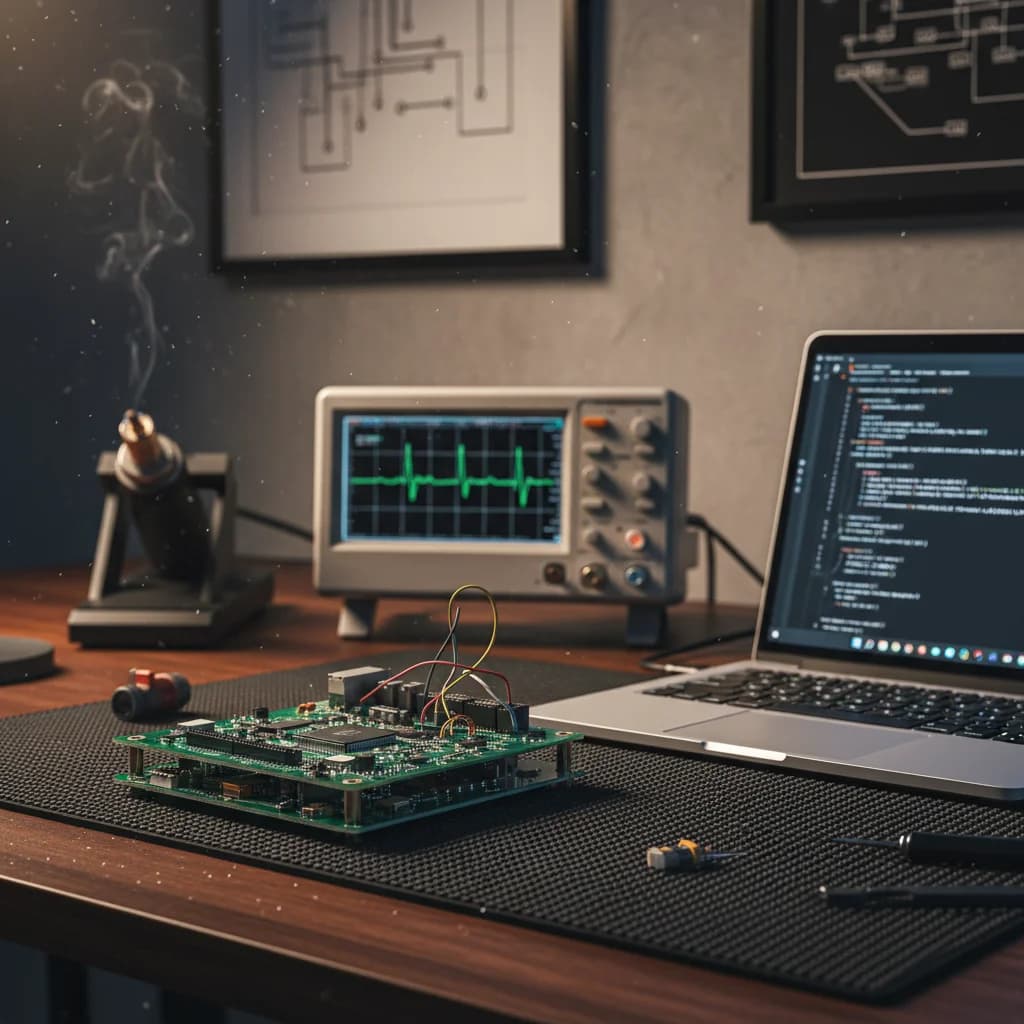
The Email Landed. Now What?
The notification hits your inbox with a thud. Subject: An Update on Our Organization. Your project, the one you’ve poured years into, is being “refocused.” Your role as a hardware engineer is gone.
It’s a gut punch. I’ve been there. You feel a mix of anger, anxiety, and a deep sense of unfairness. You designed the very silicon that powers this company, and now you’re on the outside looking in. After the initial shock wears off, a bigger question looms: Where do you go from here when it feels like the entire industry is chasing AI software roles?
Here’s the truth they don’t tell you in the corporate all-hands: your hardware background is not a liability; it’s your secret weapon for a pivot into AI. The world is drowning in inefficient AI models running on generic hardware. The next frontier isn’t just about bigger models; it’s about running them faster, cheaper, and with less power. And who understands performance, power, and the metal better than you?
This isn’t about becoming a generic Python developer. This is about leveraging your core strengths to step into some of the most critical and future-proof roles in the AI ecosystem.
Your Unfair Advantage: Why Hardware Expertise Is Gold
Software-only AI engineers often treat hardware as a black box. They write PyTorch code, throw it at a GPU, and pray for the best. When it's slow, they often don't know why. You do.
You understand things they don't:
- Memory Hierarchy: You know the painful cost of a cache miss. You understand the difference between HBM and GDDR6 and why it matters for training massive transformer models. This is crucial for performance optimization.
- Parallelism: Concepts like SIMD, MIMD, and dataflow architectures aren't abstract textbook terms for you. You’ve lived and breathed them. This is the very foundation of how GPUs and other AI accelerators work.
- Power and Thermal Constraints: You know that every computation generates heat. This is a massive issue for deploying AI on edge devices and in dense data centers. Your experience in designing power-efficient systems is directly applicable to building sustainable AI infrastructure.
- System-Level Thinking: You’re used to thinking about how components—from the CPU to the memory controller to the PCIe bus—interact. This is exactly the mindset required for an ML Systems Engineer, one of the most sought-after roles today.
Key Takeaway: Stop thinking of yourself as just a hardware engineer. Start thinking of yourself as a systems expert who understands computation from the transistor up. That’s a perspective pure software engineers can't fake.
The Pivot Playbook: A Four-Step Action Plan
Transitioning requires a deliberate strategy. It’s not about enrolling in a six-month bootcamp and hoping for the best. It’s about methodically bridging the gap between your current expertise and your target role.
Step 1: Master the Bridge Technologies
Your goal isn't to learn all of AI. It's to learn the specific tools that connect your hardware knowledge to the software stack.
- Python & PyTorch: This is non-negotiable. Python is the language of AI, and PyTorch is the industry-standard framework. You don't need to become a web developer, but you must be proficient enough to build, train, and debug a neural network. Focus on understanding tensors, autograd, and how to structure a training loop.
- CUDA C++: This is your golden ticket. NVIDIA's CUDA allows you to write C++ code that runs directly on the GPU. As a hardware engineer comfortable with C/C++, this is your most natural entry point. Learning how to write custom CUDA kernels to accelerate a specific part of a model is a high-value skill that few possess. It directly leverages your understanding of parallel processing.
- Foundational ML Concepts: You don't need a Ph.D. in statistics, but you need to understand the fundamentals. What is a loss function? What are gradient descent, backpropagation, and transformers? Andrew Ng's classic Machine Learning Specialization is still a great starting point for the theory.
Step 2: Translate Your Resume, Don't Replace It
Your biggest mistake would be to hide your hardware background. You need to reframe it in the language of AI.
| Your Old Hardware Task | How to Reframe It for AI Roles |
|---|
| Designed a low-power ASIC for signal processing | "Engineered power-efficient silicon architecture, a key skill for deploying LLMs on resource-constrained edge devices." |
| Wrote Verilog for a high-throughput memory controller | "Architected high-bandwidth data pathways, demonstrating deep knowledge of memory systems critical for alleviating I/O bottlenecks in AI training." |
| Validated system performance using low-level benchmarks | "Specialized in performance analysis and hardware-level bottleneck identification, essential for optimizing ML model inference latency." |
Your resume should tell a story: "I am a systems expert who has spent my career optimizing performance at the hardware level, and now I am applying that deep knowledge to the AI software stack."
Step 3: Build Projects That Showcase Your Unique Skills
Forget building another cat-vs-dog image classifier. Your projects need to scream "hardware-aware AI expert."
- Project Idea 1: CUDA Acceleration. Take a standard operation from a PyTorch model (like a specific type of attention mechanism) and write a custom CUDA kernel for it. Then, benchmark it against the native PyTorch implementation and write a report showing how and why your version is faster.
- Project Idea 2: Quantization Analysis. Take a pre-trained model and quantize it from FP32 to INT8. Analyze the performance uplift versus the accuracy drop on a specific piece of hardware (even a consumer GPU). This shows you understand the trade-offs between performance and precision.
- Project Idea 3: Build a Simple Inference Engine. Use a library like ONNX Runtime to run a model in C++. This demonstrates you can work outside the Python ecosystem and understand the full deployment pipeline.
Host these projects on GitHub with clean code and detailed READMEs. This is your new portfolio.
Step 4: Network with a Purpose
Don't just blast your resume out. Identify the teams and companies where your hybrid skills are most valued.
- Target Companies: NVIDIA, Google (TPU team), Apple (Neural Engine team), AMD, Intel, and countless AI hardware startups (like Tenstorrent, Cerebras, or SambaNova).
- Target Roles:
- ML Systems Engineer
- AI/ML Performance Engineer
- GPU/ASIC Design Engineer (for AI Accelerators)
- Hardware/Software Co-Design Engineer
Use LinkedIn to find people with these titles who previously held roles like yours. Send them a connection request with a message like:
"Hi [Name], I'm a hardware engineer with a background in [Your Specialty], and I was really impressed by your work on [Their Project]. I'm currently pivoting into ML systems and would love to ask you one or two questions about how you leveraged your hardware skills in your transition. Any advice would be greatly appreciated."
This is specific, respectful, and shows you've done your homework.
Warning: Avoid applying for generic "AI Research Scientist" or "Applied Scientist" roles unless you have a relevant Ph.D. These roles are heavily focused on algorithmic innovation. Your strength lies in implementation and optimization. Play to your strengths.
This Is a Pivot, Not a Leap of Faith
Getting laid off feels like a step backward, but it can be the catalyst for a massive step forward. The AI industry has a growing blind spot: a shortage of people who truly understand the hardware that underpins everything. The demand for pure software engineers who can call a library function is flattening. The demand for experts who can make that function run 10x faster and use half the power is exploding.
You already have the hardest part of the equation down: a deep, intuitive understanding of how computers actually work. The rest is just learning a new abstraction layer.
Don't mourn the job you lost. Focus on building the skills for the job you’ll land next—one that’s more durable, more valuable, and sits at the critical intersection of hardware and AI. Your next chapter starts now. Go build it.