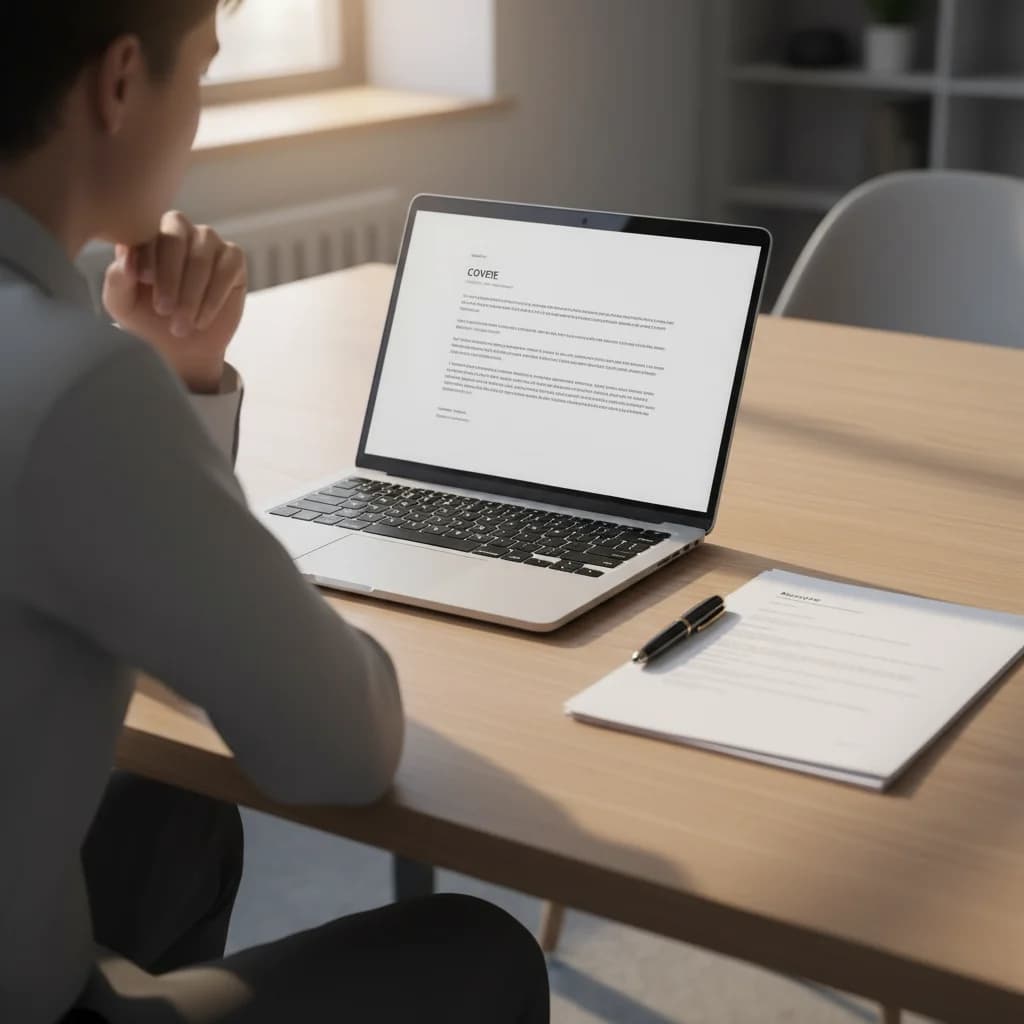
How long should a cover letter be? For a standard job application, aim for one readable page, usually about 250–400 words. That is the range in Princeton's cover-letter guidance. Use it as a starting point, then follow the employer's instructions on length, content, and format.
A useful letter explains the role you want, the evidence for your fit, and your interest in that employer. Extra words should add relevant evidence, not repeat the resume or inflate a simple sentence. A shorter email that introduces an attached cover letter serves a different purpose from the letter itself.
| What the employer requests | A useful starting point | What takes precedence |
|---|
| Standard cover-letter attachment | One readable page, approximately 250–400 words | Any stated page or word limit and the requested content |
| Cover letter written in the email body | A concise standalone letter with relevant evidence | The employer's email instructions; do not add an attachment unless requested or appropriate |
| Brief email accompanying a separate letter | A short introduction identifying the role and attachments | The email should not duplicate the entire attached letter |
| Portal text box | A tailored answer that fits the stated field limit | The portal's character or word limit and the actual prompt |
| Supporting statement or academic application | Enough detail to address the requested criteria | The vacancy's instructions; a standard one-page letter may not be the requested document |
Oxford's guidance also recommends a one-page standard letter while explaining that academic applications can require a different length. Treat the word range as an editing aid, not an automatic screening threshold.
What to Put in Three or Four Short Paragraphs
Use the space to answer the employer's likely questions. This is an editorial outline, not a required allocation of words.
- Opening: Name the vacancy and the relevant experience or qualification that connects you to it.
- Evidence: Explain one or two contributions that show how you meet important requirements. Include your actions and a result you can substantiate.
- Employer fit: Connect that experience to the responsibilities or organization. You can combine this with the evidence paragraph.
- Closing: Invite a conversation, mention attachments if appropriate, and sign off without repeating the whole introduction.
If you have little experience, use a relevant project, placement, or volunteer contribution. If you have extensive experience, choose the evidence that best fits this vacancy rather than compressing your entire career into the letter.
A Complete Cover Letter: 268 Words
This is an original, fictional example for an Operations Coordinator application. The person, organization, work history, and results are illustrative. Replace all claims with your own experience. The count includes the greeting and sign-off and excludes a contact-information header.
Dear Hiring Team,
I am applying for the Operations Coordinator position at Example Supply Services. In my current administrative role, I support scheduling, order tracking, and communication between the service and warehouse teams. Your posting's emphasis on reliable handoffs and accurate records matches the work I most enjoy: making it easier for colleagues to see what needs attention and who owns the next step.
When our team found that urgent requests were arriving through several channels, I helped create a shared intake log and a short handoff checklist. I gathered feedback from the colleagues who would use it, clarified the required fields, and documented when an issue needed escalation. During a twelve-week trial, missing handoff details in our weekly sample fell from fourteen to six. That was a team result, and I can explain how we collected the sample and where the process still needed improvement.
I also maintain recurring schedules and prepare concise updates for colleagues with different priorities. I check uncertain information with the person responsible instead of passing an assumption to the next team. Recently, I helped a new colleague learn our tracking process by working through sample requests together and turning their questions into clearer instructions. That experience reinforced the value of a simple process that people can actually follow.
I would welcome the opportunity to bring this approach to your operations team and learn more about the coordination challenges described in the vacancy. My attached resume provides additional detail on my responsibilities. Thank you for considering my application; I would be pleased to discuss how my experience matches the role.
Sincerely,
Jordan Taylor
What makes this length useful
The opening identifies a role and a practical fit. The next two paragraphs give different evidence: a process improvement and everyday collaboration. The close is brief. The sample has enough detail to discuss in an interview without adding a biography, a list of unrelated skills, or a second version of the resume.
A word count does not guarantee that a letter will fit on one page. Add your contact header, use readable formatting, and inspect the final file. If it runs over, cut repeated material before reducing text size or margins.
A Brief Email With an Attached Letter: 104 Words
Use this example only when you are sending a separate resume and cover letter. The subject is Application: Operations Coordinator — OC-104 — Jordan Taylor. The body count below excludes that subject and includes the greeting and sign-off.
Dear Hiring Team,
Please find attached my application for the Operations Coordinator position, reference OC-104. My resume and cover letter outline my experience in scheduling, request tracking, and improving handoffs between service and warehouse colleagues.
I am particularly interested in the coordination responsibilities described in your vacancy. In my current role, I helped develop a shared intake log and checklist so colleagues could identify the next action and its owner. I would welcome the chance to discuss how that experience could support your team.
Thank you for considering my application. Please let me know if you need any additional information.
Best regards,
Jordan Taylor
This email points the reader to the attached application and gives a short reason for interest. It is not meant to replace a standalone cover letter when the employer requests one. If the instructions ask for the cover letter in the email body, put your tailored letter there instead of sending this short introduction alone.
For more detail, see our email versus traditional cover letter guide.
Before and After: Cut Repetition, Keep the Evidence
The following paragraph uses the same fictional project as the full letter. The goal is to preserve the contribution, observation period, and result while removing a long lead-in and a generic conclusion.
Before: 105 words
Throughout the course of my time in my current position, I have had the opportunity to be involved in a number of different tasks that relate to the important area of coordination. One example that I would particularly like to highlight is a project where our team was receiving urgent requests through a variety of different channels. I worked with colleagues to create a shared intake log and a handoff checklist. During a twelve-week trial, the number of missing handoff details in our weekly sample went down from fourteen to six. I believe this example demonstrates my ability to contribute positively to improving coordination processes.
After: 49 words
I helped colleagues create a shared intake log and handoff checklist for urgent requests arriving through several channels. During a twelve-week trial, missing handoff details in our weekly sample fell from fourteen to six. This gave the team clearer next actions and a process we could continue to review.
What changed: The edit removes 56 words. It starts with the action, names the process, and keeps the twelve-week period and the change from fourteen missing details to six. It also keeps the applicant's role as a contributor rather than turning a team project into a solo achievement.
Use the same test on your draft: if a sentence only announces that you have experience, replace it with the experience itself. If the evidence is not relevant to this vacancy, remove it rather than polishing it into a longer paragraph.
A Five-Pass Editing Method
- Check the instructions first. Confirm the requested document, file type, and any word or character limit. If the employer says not to submit a cover letter, follow that instruction.
- Keep the strongest evidence. Mark the two or three requirements for which you have the clearest examples. Remove unrelated experience and lists already covered by the resume.
- Cut repeated openings and conclusions. Phrases that announce your enthusiasm or confidence can usually be shortened. Preserve the specific reason for interest and the evidence for fit.
- Check every claim. Keep metrics only when you can explain what was measured, over what period, and how you contributed. A concise letter still needs accurate qualifications and results.
- Read and inspect the final version. Read it aloud, remove remaining repetition, and check the document after export. Confirm that the header, greeting, paragraphs, and sign-off remain readable.
For a profession-specific example, our social work cover letter samples show complete entry-level and experienced letters with paragraph annotations.
Use a clear paragraph layout and a readable font. Keep enough space between paragraphs for the letter to be scanned comfortably. Choose the file type the employer requests and inspect the exported file for line breaks, missing text, and an accidental second page.
If a portal offers a preview or extracted-text view, check that the content is present and in the intended order. Follow its upload instructions. A word-count recommendation is not proof that an applicant tracking system automatically accepts or rejects a letter at that number.
Keep the filename descriptive, confirm that you attached the intended version, and remove drafting notes and placeholders. Include relevant contact details without turning the header into a large decorative block that crowds out your evidence.
Frequently Asked Questions
Is a 500-word cover letter too long?
For a standard application, 500 words is a good reason to review the draft for repetition and relevance. Start by cutting a repeated biography or resume summary. Follow the employer's actual instructions; the number alone does not establish whether the letter will be accepted or rejected.
Is a 150-word cover letter too short?
There is no useful minimum independent of the task. A short email accompanying an attached letter can be appropriate. For a standalone letter, check that you still explain the role, your relevant evidence, and your interest. Do not add filler just to reach a target.
Should a cover letter be one page or two?
Use one page as the default for a standard letter. A supporting statement or academic application may ask for more detail. Read the vacancy carefully and submit the document it requests rather than treating every application as the same format.
What if the application has a character limit?
Use the portal's own counter and rules. Word counts and character counts are different, and spaces or line breaks may be counted by the field. Keep the required evidence within the displayed limit and check the final submission preview when available.
Counting tools can differ. The examples in this guide count the greeting and sign-off, but exclude a contact header and email subject. If an employer specifies a counting method, follow it. The final page layout still matters.
Can AI help shorten my cover letter?
It can help identify repetition and propose clearer wording. Review the result to ensure it preserves your actual responsibility, qualifications, and evidence. Follow employer rules on AI use and keep confidential information out of drafting tools.
Build a Concise Draft From Your Own Evidence
You can draft a cover letter around the role, then compare the output with the vacancy. Check each claim, replace generic wording with your own examples, and edit for relevance before checking the final length.
Next step: Create an editable cover-letter draft using your real experience and the job description. Keep the strongest evidence and inspect the final document before sending.
Sources and Counting Notes
Guidance checked November 3, 2026: Princeton's cover-letter principles and Oxford's cover-letter guidance. The examples and editing method are original teaching material, not letters supplied or endorsed by those universities.
Example counts use whitespace-separated words. The full letter is 268 words; the email body is 104 words; the editing example changes from 105 to 49 words. Names, employment details, and results are fictional, and should not be copied as personal history.